Swift TIL 7
Initially self-taught back in the early 1980s, I started programming on a ZX81 and I've been in love with software development ever since. My "primary" language has drifted over the years, but as it has I've made an effort to get to know and work with plenty of others.
These days I do a lot of Python/Django/JavaScript work, while having fun working with bioinformaticians and machine learning scientists.
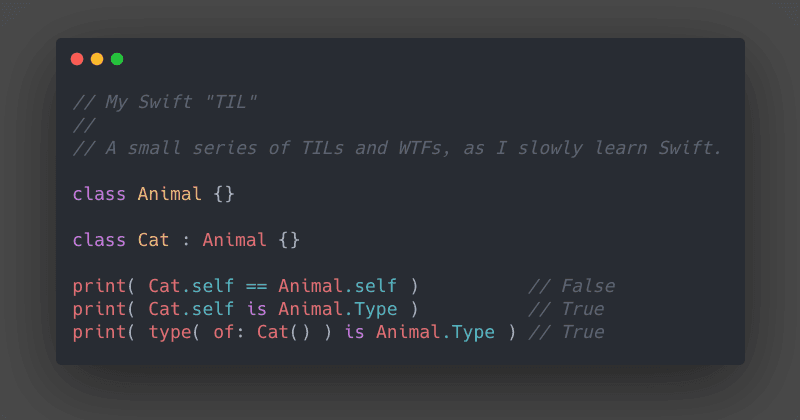
This post is very much a case of me writing it down to try and get it all straight in my head, and to make sure it sticks. The other day I was reading about Swift's types and type-equality checks, and as I'd expect from plenty of other languages I've worked with, there's a way for checking that two types are the same, such that super/subclasses aren't taken into account, and a way where they are. So, given this silly code:
class Animal {}

class Cat : Animal {}

print( Cat.self == Animal.self )          // False
print( Cat.self is Animal.Type )          // True
print( type( of: Cat() ) is Animal.Type ) // True
it's made clear that == checks for strict equality and a super/subclass relationship isn't taken into account. On the other hand is does take it into account.
Only... what's with this whole .self sometimes and .Type other times business? That took a little bit of writing code and playing to get comfortable with. Here's how I understand it now (and do feel free to correct me below if I'm way off):
Given the above code, Animal.Type is the type of a value that expresses the type of Animal. On the other hand, Animal.self is a value that is the type of an Animal. Yeah, I know, that still reads oddly. But written as code:
let feline : Cat.Type = Cat.self
I think it makes a lot more sense. And having got there I felt I better understood it. I'm not 100% sure I'm 100% with it, but I'm getting there.